Tensile Testing: The Most Common Application
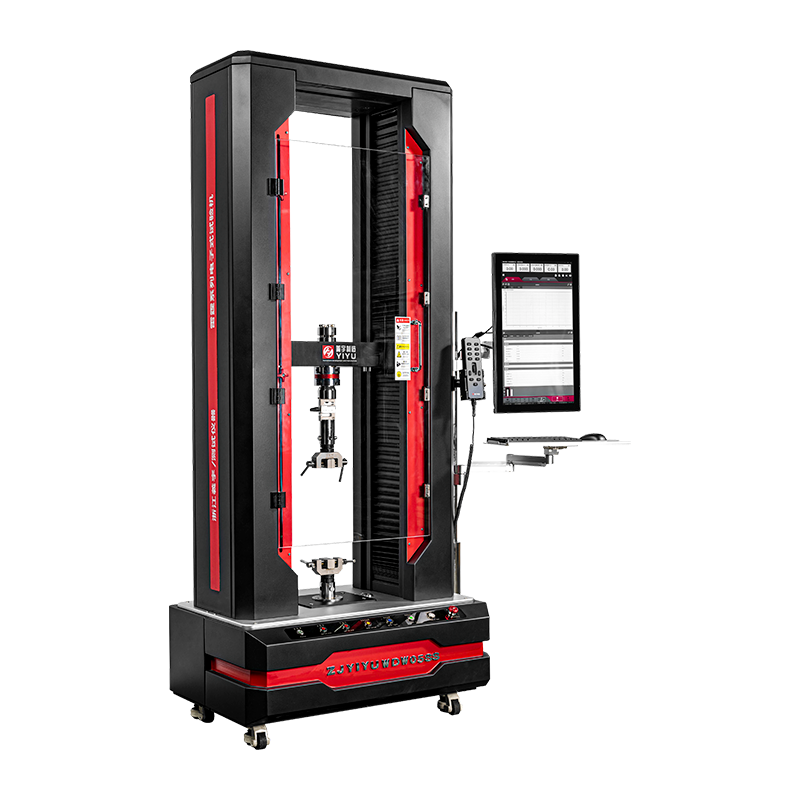
Tensile testing is the most frequently performed test on a universal testing machine. The specimen is pulled apart at a controlled rate until it fractures. Key parameters measured include:
- Ultimate tensile strength (UTS) — the maximum stress a material can withstand
- Yield strength — the stress at which permanent deformation begins
- Elongation at break — a measure of ductility
- Young's modulus (elastic modulus) — stiffness of the material
Tensile tests apply to metals, plastics, rubber, textiles, films, adhesives, and composites. Standards such as ASTM E8/E8M (metals), ISO 6892-1, and ASTM D638 (plastics) govern these procedures. A typical steel specimen may have a gauge length of 50 mm and be tested at a crosshead speed of 2 mm/min.
Compression Testing: Measuring Load-Bearing Capacity
Compression testing evaluates how a material or component behaves under compressive (crushing) loads. The machine applies a downward force onto the specimen between two platens. Results include compressive strength, compressive modulus, and deformation behavior.
Common applications include:
- Concrete cylinders (compressive strength commonly ranges from 20 to 40 MPa for standard structural concrete)
- Foam and packaging materials
- Bone and biomaterials in medical research
- Springs and elastomers
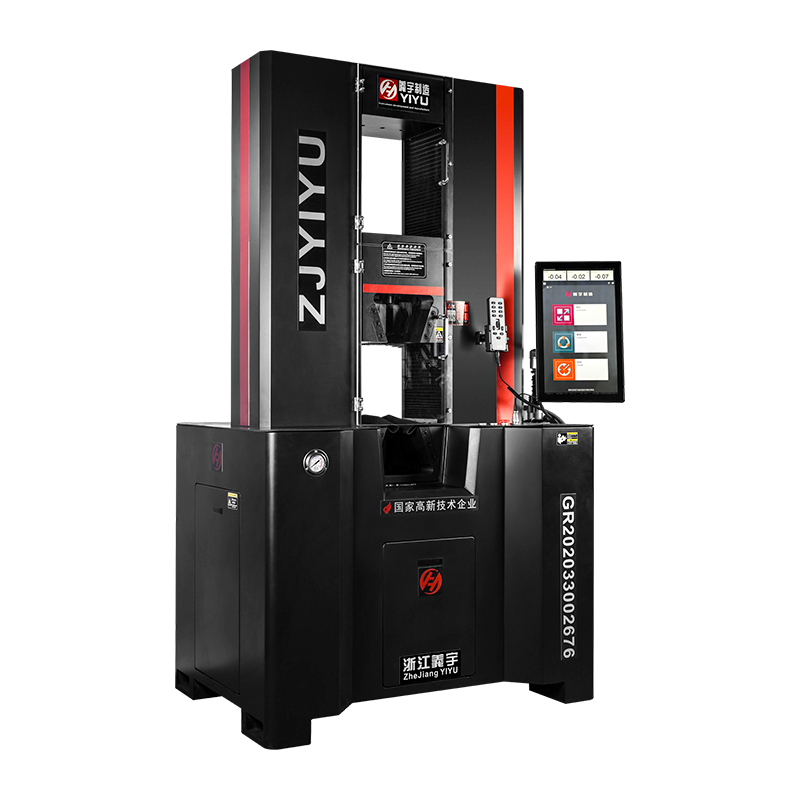
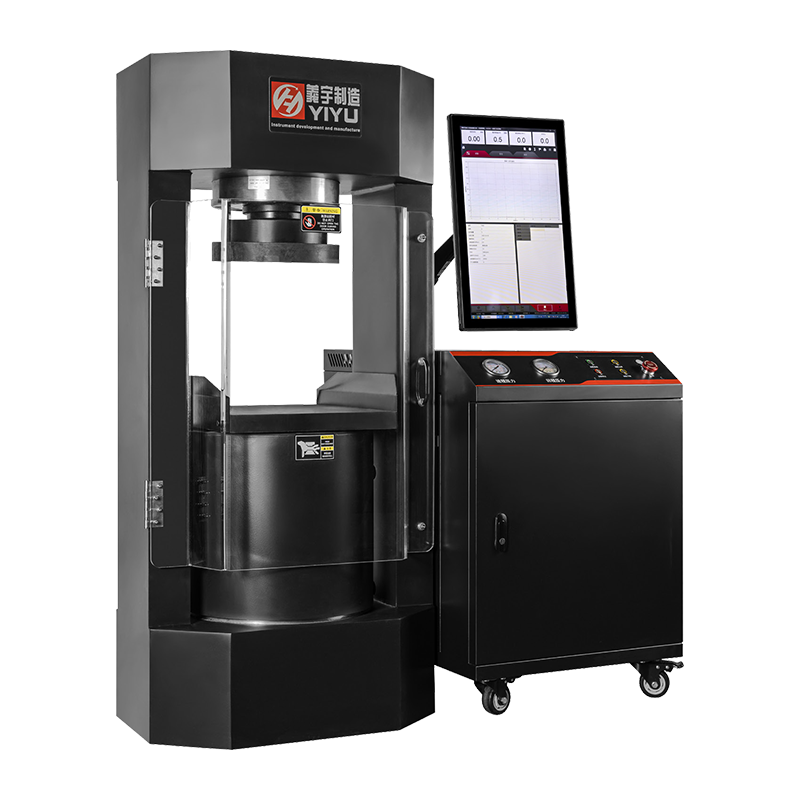
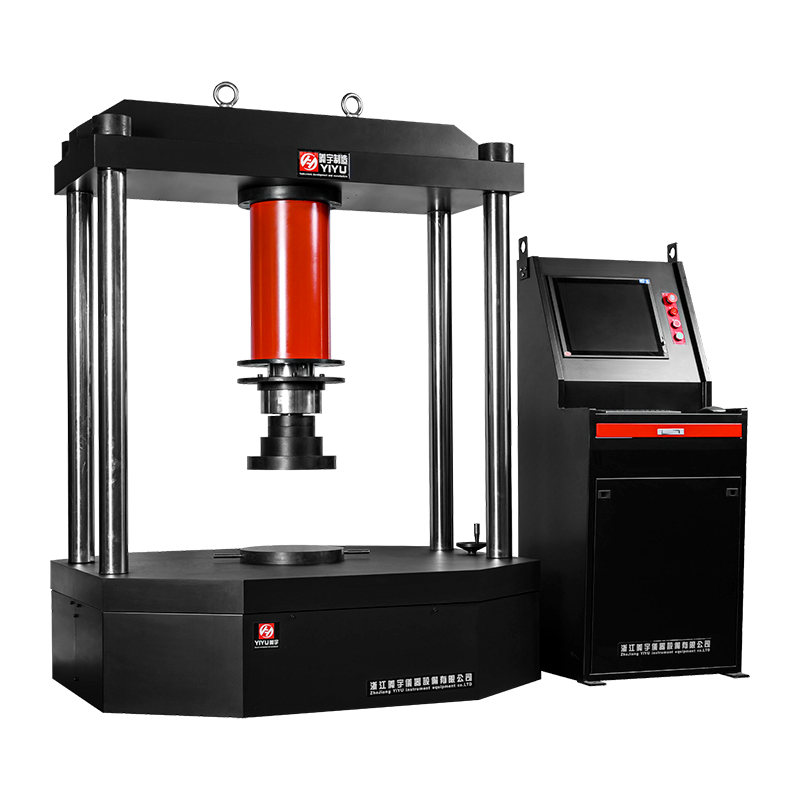
Relevant standards include ASTM C39 for concrete and ISO 604 for plastics. Hydraulic Universal Testing Machines are often preferred for high-force compression tests exceeding 500 kN, such as structural concrete and heavy metal components.
Flexural (Bend) Testing: Evaluating Bending Resistance
Flexural testing — also called a bend test or three-point/four-point bending test — measures a material's resistance to bending forces. The specimen rests on two supports while a load is applied at the center (three-point) or two inner points (four-point).
Key outputs include flexural strength and flexural modulus. This test is critical for:
- Ceramics and glass (where tensile testing is impractical due to brittle fracture)
- Fiber-reinforced composites and carbon fiber panels
- Plastics per ASTM D790 and ISO 178
- Timber and construction lumber
For example, a standard polypropylene specimen tested per ISO 178 would typically exhibit a flexural modulus of approximately 1,300–1,800 MPa.
Shear and Torsion Testing
Shear testing determines how a material responds to forces applied parallel to its cross-section. Universal testing machines can be equipped with shear fixtures to conduct:
- Single-lap and double-lap shear tests — for adhesives and bonded joints (per ASTM D1002)
- Interlaminar shear strength (ILSS) — for composite laminates
- Pin shear tests — for fasteners and bolted connections
Torsion testing, while typically done on dedicated torsion machines, can also be performed on UTMs equipped with torsion attachments to measure shear modulus and twist-to-failure behavior.
Peel and Adhesion Testing
Peel testing quantifies the bond strength of adhesive materials, tapes, coatings, and films. The universal testing machine pulls one bonded layer from another at a defined angle — commonly 90° or 180°. Peel force is measured in N/mm or N/25mm.
Typical test configurations include:
- T-peel test (ASTM D1876) — for flexible laminates
- 180° peel test (ASTM D903) — for pressure-sensitive tapes
- 90° peel test — for medical device adhesives and packaging
Electronic Universal Testing Machines are particularly well-suited for peel testing because of their precise low-force control, often measuring forces as low as 0.01 N with high-resolution load cells.
Fatigue Testing on Universal Testing Machines
Fatigue testing subjects a specimen to repeated cyclic loading to determine how long it withstands stress before failure. While dedicated fatigue testing systems exist, many modern UTMs — especially servo-hydraulic models — support cyclic fatigue testing at defined frequencies.
Key parameters include:
- S-N curves (Wöhler curves) — stress amplitude vs. number of cycles to failure
- Fatigue limit — stress below which the material can endure infinite cycles
- Crack propagation rate — per ASTM E647
Hydraulic Universal Testing Machines typically operate at frequencies up to 10–50 Hz for fatigue testing, making them effective for automotive, aerospace, and structural engineering components.
Hardness and Fracture Toughness Testing
Although dedicated hardness testers (Rockwell, Vickers, Brinell) are standard instruments, some UTMs can be fitted with indentation fixtures to conduct instrumented indentation testing, providing hardness and elastic modulus data simultaneously.
Fracture toughness testing — measuring a material's resistance to crack propagation — is also performed on UTMs. Common test methods include:
- KIC (plane-strain fracture toughness) per ASTM E399
- J-integral testing per ASTM E1820 for ductile metals
- CTOD (Crack Tip Opening Displacement) — relevant for structural steel and weld quality
Electronic vs. Hydraulic Universal Testing Machine: Test Capability Comparison
The type of universal testing machine significantly influences which tests are practical. The table below summarizes key differences:
Table 1: Comparison of Electronic and Hydraulic Universal Testing Machine capabilities across common test types
| Test Type |
Electronic UTM |
Hydraulic UTM |
| Tensile (low–medium force) |
Excellent (0.001–600 kN) |
Good |
| Tensile (high force >600 kN) |
Limited |
Excellent (up to 3,000+ kN) |
| Compression |
Good |
Excellent |
| Flexural |
Excellent |
Good |
| Peel / Adhesion |
Excellent |
Limited |
| Fatigue (cyclic) |
Limited (low frequency) |
Excellent (up to 50 Hz) |
| Fracture Toughness |
Good |
Excellent |
| Speed / Displacement Accuracy |
Very high (servo motor) |
Moderate |
Specialized Tests Performed with Fixtures and Accessories
The versatility of a UTM is dramatically expanded through interchangeable fixtures and environmental chambers. With the right accessories, the following specialized tests can also be conducted:
Creep and Stress Relaxation Testing
Creep testing applies a constant load over an extended period (hours to weeks) to measure time-dependent deformation. Stress relaxation tests hold a fixed deformation and monitor the decrease in stress. These are critical for polymers, solder joints, and high-temperature alloys.
High and Low Temperature Testing
Environmental chambers mounted on UTMs allow testing from -70°C to +350°C, enabling evaluation of materials in operational temperature ranges. This is essential for aerospace components, automotive gaskets, and cold-chain packaging.
Textile and Yarn Tensile Testing
With pneumatic or capstan grips, UTMs test individual yarns, woven fabrics, geotextiles, and nonwovens per standards like ISO 13934-1 and ASTM D5034, measuring breaking force and elongation.
Medical Device and Biomechanical Testing
UTMs are widely used in the medical field to test sutures, stents, catheters, bone screws, and implants. These applications require compliance with ISO 10993 and ASTM F543 (bone screws). Force resolution can be as fine as 0.001 N for delicate tissue testing.
Industry Applications and Standards Overview
Universal testing machines serve virtually every industry. Below is a summary of common sectors, tests performed, and governing standards:
Table 2: Industry applications of universal testing machines with corresponding tests and standards
| Industry |
Typical Tests |
Key Standards |
| Metals & Alloys |
Tensile, Compression, Fatigue |
ASTM E8, ISO 6892-1 |
| Plastics & Polymers |
Tensile, Flexural, Creep |
ASTM D638, ISO 178 |
| Construction / Civil |
Compression, Rebar Tensile |
ASTM C39, EN 12390 |
| Automotive |
Fatigue, Shear, Peel |
ISO 6892, ASTM D1002 |
| Medical Devices |
Tensile, Flexural, Pull-out |
ASTM F543, ISO 10993 |
| Textiles & Packaging |
Tensile, Tear, Peel |
ISO 13934-1, ASTM D882 |
| Composites & Aerospace |
Interlaminar Shear, Flexural |
ASTM D2344, EN 2563 |
Choosing the Right Universal Testing Machine for Your Tests
When selecting between an Electronic Universal Testing Machine and a Hydraulic Universal Testing Machine, the primary factors to consider are force range, test type, and required accuracy:
- Choose an Electronic UTM for forces below 600 kN, precise low-speed tests, peel tests, medical device testing, and applications requiring high displacement resolution (as fine as 0.001 mm).
- Choose a Hydraulic UTM for heavy industrial testing above 600 kN, high-cycle fatigue, structural steel, concrete, and large-section forgings or castings.
- Both types support tensile, compression, flexural, shear, and peel tests across the full material spectrum when properly equipped with fixtures.
Laboratories conducting diverse material tests should ensure the UTM software supports multiple test standards simultaneously and allows for easy fixture changeover — reducing setup time and expanding testing throughput.


 简体中文
简体中文